
OutIn Mino Review: Is This Compact Espresso Maker Worth It?
This OutIn Mino review looks at the newer, outdoor-focused sibling of the popular Nano and asks whether faster heating, quicker charging, a smaller body, and IP67-rated protection make it the better travel machine. Mino combines a built-in heater, rechargeable electric pump, 70 ml water tank, 12 g ground-coffee basket, capsule compatibility, and one-button brewing in a 685 g cylindrical body.
Its strongest advantages are convenience and travel readiness. OutIn says the Mino can heat 50 ml of 25°C / 77°F water to 93.3°C / 199.9°F in 149 seconds, produce up to six cold-water brews per charge, recharge from 20% to 80% in about 45 minutes, and reach a full charge in roughly 90 minutes. Those are manufacturer lab figures, so real results can vary with water volume, starting temperature, weather, battery condition, and coffee preparation.
As an Amazon Associate I earn from qualifying purchases.
OutIn Mino Review: Quick Verdict
The OutIn Mino is a strong fit for travelers who want a self-heating espresso maker that is compact, fast to recharge, and better prepared for outdoor conditions than a typical portable electric machine. It is particularly attractive for camping, road trips, hotels, hiking basecamps, RVs, and frequent travel where built-in water heating removes the need for a kettle.
The main limitation is coffee capacity. The standard basket tops out at 12 g, so the Mino is more naturally a single-shot or compact lungo machine than a large double-shot system. Unlike the Nano, it does not currently have the same 16–18 g Basket Plus path. Buyers who prioritize a larger dose over ruggedness may therefore prefer the Nano with Basket Plus or a more configurable alternative.
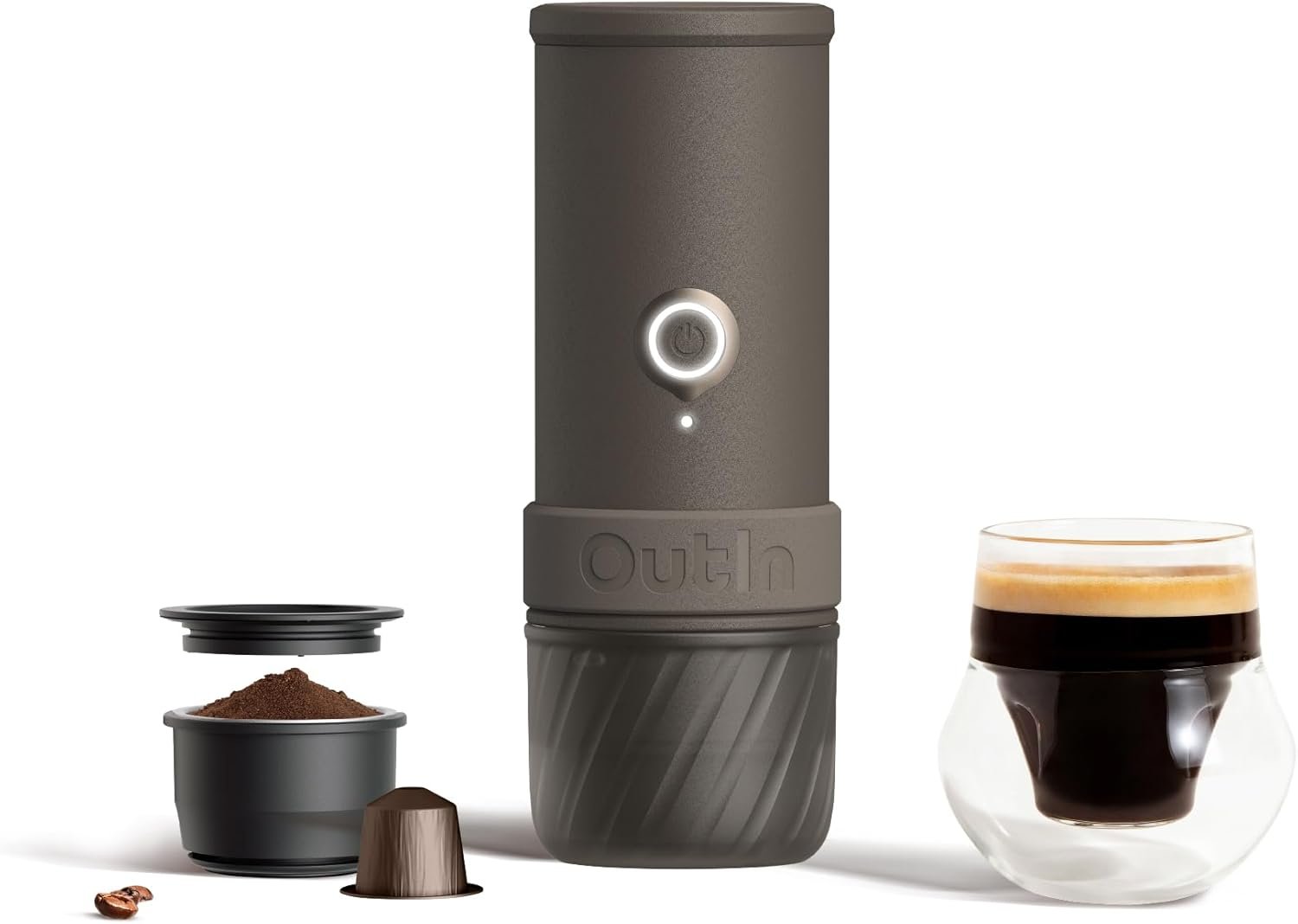
OutIn Mino Portable Electric Espresso Machine
Mino is OutIn's compact self-heating travel model built around faster charging and an outdoor-oriented design. It can brew from ground coffee or Nespresso Original-size capsules and can start with either cold or already-hot water.
*Manufacturer-reported lab figures. Performance can vary with conditions and use.
Check OutIn Mino on AmazonDesign and Portability: Small, but Not Ultralight
At 67 mm in diameter and 195 mm tall, the Mino is genuinely compact for a machine that includes a heater, battery, pump, water tank, brewing chamber, and drinking cup. Its narrow cylindrical shape is easier to fit into a backpack side pocket, car console, luggage compartment, or camping bin than a conventional coffee maker.
Weight needs more context. At 685 g, it is only slightly heavier than the OutIn Nano, but far heavier than simple manual brewers such as a Nanopresso or AeroPress. The extra mass buys you something useful: water heating and automatic extraction. If you already carry a stove and do not mind manual pumping, a lighter brewer can still make more sense.
Mino uses food-contact stainless steel plus a Tritan cup and other food-safe materials. The included cup also protects the lower brewing area in transit, helping the machine behave more like one compact travel system rather than several loose parts.
Self-Heating: Where the Mino Earns Its Place
Built-in heating is the feature that changes the travel workflow most. OutIn rates Mino for heating 50 ml of room-temperature water from 25°C / 77°F to 93.3°C / 199.9°F in 149 seconds. After heating, the machine automatically moves into extraction.
That time sounds slower than using a kettle at home, and it usually is. But the comparison changes when there is no kettle. In a parked car, campsite, hotel room, job site, roadside stop, or outdoor setting, waiting a few minutes for the machine to heat its own water can be much more convenient than finding another appliance.
Water volume and starting temperature matter. The 149-second figure is tied to OutIn's stated lab condition of 50 ml at 25°C / 77°F. Colder water, more water, low ambient temperatures, or an aging battery can change the result.
OutIn Mino Battery Life and Fast Charging
Mino uses a 3 × 3000 mAh battery system. OutIn lists up to six brews per charge when heating room-temperature water and more than 500 extractions when you start with hot water. The enormous difference comes from the heater: moving water from room temperature to brewing temperature consumes far more energy than simply powering the pump.
Charging is one of Mino's clearest improvements over older portable machines. OutIn rates the USB-C charging system for 20% to 80% in about 45 minutes and a full charge in roughly 90 minutes when using a suitable power source.
For road trips, that matters because a machine can recover useful capacity during lunch, a hotel stop, or time in the car. For multi-day camping without reliable power, the more important strategy is still to use preheated water whenever possible.
If your routine regularly requires more than six cold-water brews between charges, this category may not be ideal without a power bank or vehicle charging plan. Self-heating convenience always comes with an energy budget.
What Does the 22-Bar Pressure Claim Actually Mean?
OutIn markets the Mino with a pump capable of up to 22 bar. That number should not be treated as a direct espresso-quality score. Maximum pump pressure is not the same thing as the pressure maintained across the coffee puck during the entire extraction.
Grind size, dose, basket design, tamping, flow resistance, coffee freshness, temperature, and the pressure profile all affect the cup. A machine advertising 22 bar is not automatically better than one advertising 20 bar or a manual machine designed to brew at a lower working pressure.
The useful takeaway is simpler: Mino has an electric pressure system designed to push water through a compact coffee basket automatically. Buyers should judge the complete workflow rather than buying whichever portable machine shows the largest pressure number.
Using Ground Coffee in the OutIn Mino
The standard ground-coffee basket accepts up to 12 g. That gives Mino more coffee capacity than the Nano's original small basket, but less than the 16–18 g dose many espresso enthusiasts expect from a full double shot.
OutIn recommends fine coffee and provides a dosing funnel plus a scoop/tamper-style tool with the machine. Because compact electric brewers have limited pump and basket headroom, more coffee or a finer grind is not always better. Overfilling or choking the basket can restrict flow and trigger a poor extraction.
Because Mino does not currently offer the same large Basket Plus system as Nano, shoppers who specifically want a 16–18 g travel dose should keep that difference in mind before choosing between the two models.
Capsule Brewing: Mino at Its Simplest
Mino supports Nespresso Original-size capsules and compatible formats. This makes the machine much easier to use in hotels, offices, cars, and on trips where you do not want to carry beans, a grinder, dosing tools, and a container for used grounds.
The capsule workflow gives up some control over grind, coffee freshness, roast, and dose, but it also removes most preparation. Insert the capsule into the adapter, add water, start the cycle, and dispose of the capsule afterward.
For frequent business travel, this may be the most practical use of the Mino. For coffee enthusiasts carrying a quality grinder, the ground-coffee basket offers more control but requires more cleanup and technique.
Camping, Hiking, Road Trips, and Outdoor Use
Mino's outdoor positioning is not just marketing around its size. OutIn gives the machine an IP67 rating for splash, water, and dust resistance and specifically targets travel and adventure use. That is meaningful for a product that may live around backpacks, campsites, wet picnic tables, dusty cars, or changing weather.
However, IP67 does not mean the machine should be deliberately submerged or treated carelessly. OutIn itself warns that resistance can decrease with wear and that liquid damage is not covered by warranty. Keep the charging area dry and treat the rating as extra protection, not permission to abuse the electronics.
Best fit: car camping and travel
This is where the Mino makes the strongest case. Its weight is less important in a car or RV, charging is easier, and built-in heating genuinely reduces gear.
Backpacking
For hikers counting ounces, 685 g is substantial. If a stove is already in your pack, a light manual brewer can be the more efficient choice. Mino makes more sense when eliminating the kettle or manual brewing process matters more than minimum carry weight.
High-Altitude and Extreme-Temperature Claims
OutIn states that the Mino is designed for stable extraction at elevations up to 5,000 meters and operation across an ambient range from -15°C / 5°F to 45°C / 113°F. These are manufacturer lab claims rather than our own field measurements.
The company also warns that very hot or cold environments can reduce battery life or change performance. That is expected behavior for lithium-battery devices. Cold-weather campers should not assume the rated six cold-water brews will always be available in freezing conditions.
For most buyers, the practical value of these specifications is reassurance that Mino was designed with outdoor environments in mind. They should not be read as a guarantee of identical heat-up speed and extraction behavior at every altitude or temperature.
Cleanup and Maintenance
Mino's capsule mode is the lowest-mess option. Ground coffee requires removing the basket, disposing of the puck, and rinsing the coffee-contact parts. Because the basket is compact, it is best to clean it before the puck dries and sticks to the metal.
The machine can also be flushed with clean water. Keep the charging port dry, let removable parts drain before storage, and avoid sealing damp accessories inside the travel cup for long periods.
Periodic descaling is also sensible because minerals accumulate wherever water is heated. Frequency depends on water hardness and use, but travelers who regularly fill from different municipal water sources should pay more attention than someone using filtered water at home.
OutIn Mino Pros and Cons
Pros
- Self-heats room-temperature water
- Fast manufacturer-rated 149-second heating cycle
- 20%–80% USB-C charging in about 45 minutes
- Ground coffee and Original-size capsule support
- Compact 67 × 195 mm body
- IP67-rated splash, water, and dust resistance
- Up to six cold-water brews per charge under manufacturer test conditions
- Outdoor-focused design for travel, camping, and road trips
Cons
- 685 g is heavy compared with manual travel brewers
- Standard ground-coffee capacity stops at 12 g
- No Nano-style 16–18 g Basket Plus option at present
- Cold-water heating still limits battery endurance
- 22-bar maximum pressure should not be mistaken for a quality score
- More electronics and seals than a simple manual brewer
- IP67 resistance can decline with normal wear
OutIn Mino Alternatives
Mino's main selling points are ruggedness, quick charging, compact dimensions, and self-heating. Other machines can be better when your priority shifts toward a larger coffee dose, more brew control, or manual simplicity.
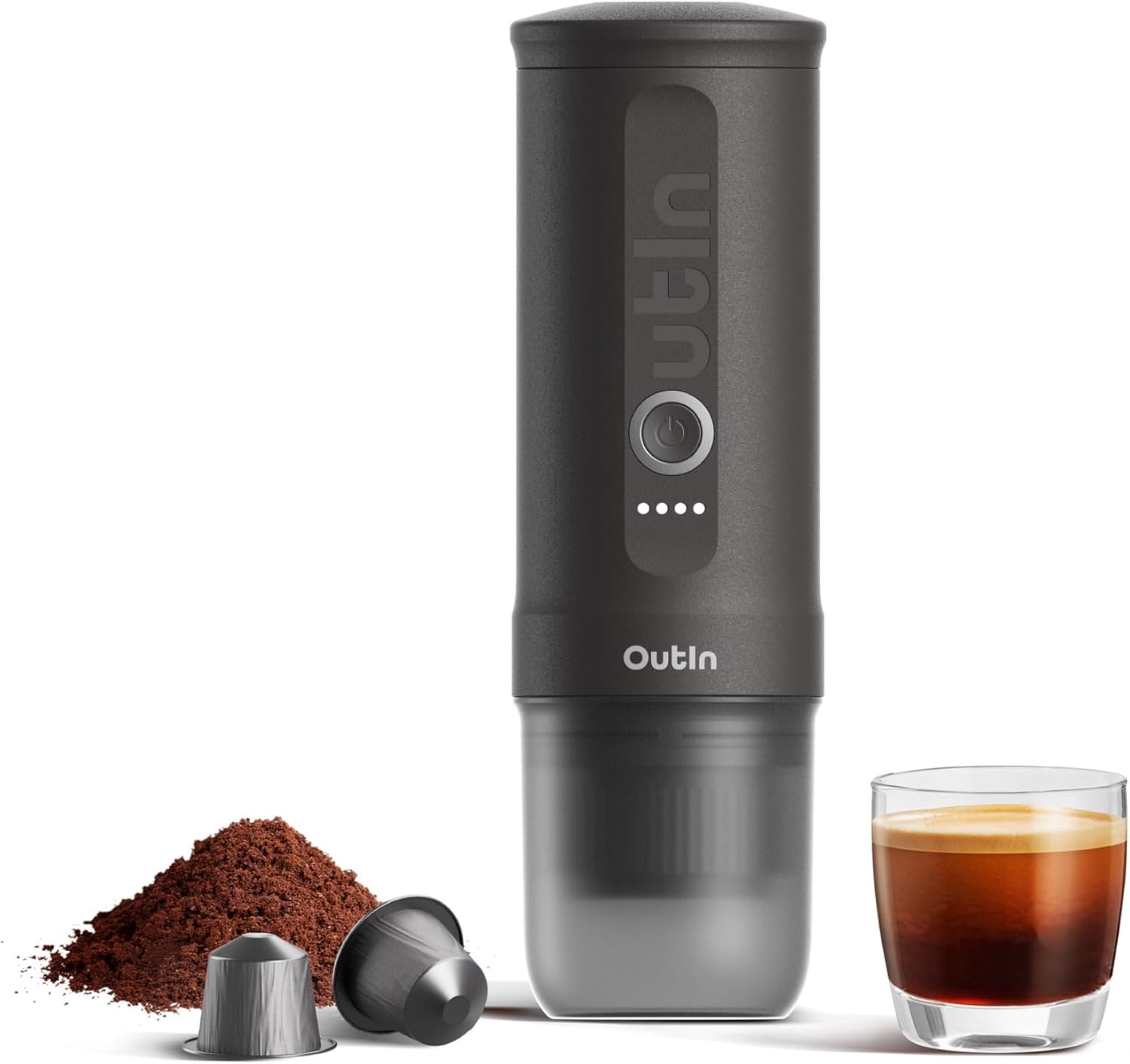
OutIn Nano
Nano is slightly lighter and has the important option of a 16–18 g Basket Plus. Mino counters with faster charging, a smaller body, stronger outdoor protection, and a larger standard basket.
Read the OutIn Nano Review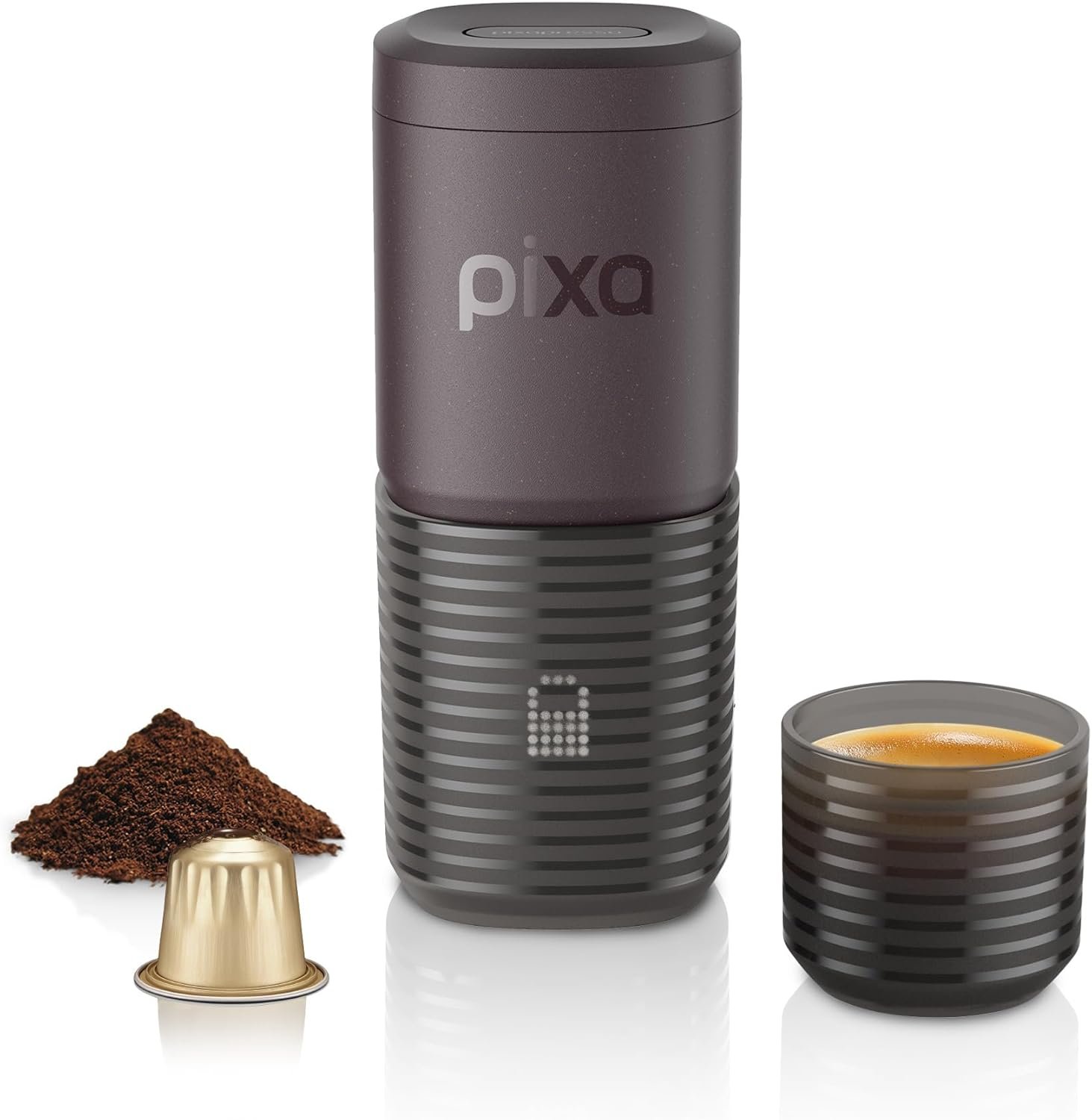
WACACO Pixapresso
Pixapresso is the better fit if you want multiple temperatures, pre-infusion control, a larger water tank, and more dose flexibility rather than Mino's simpler outdoor-focused workflow.
Check Pixapresso on Amazon
WACACO Picopresso
Picopresso is far more manual but offers an 18 g basket and enthusiast-focused puck preparation. Choose it if espresso control matters more than self-heating convenience.
Read the Picopresso ReviewFor the full electric category, see our battery-powered portable espresso maker guide.
Who Should Buy the OutIn Mino?
Buy the Mino if...
- You frequently travel where hot water is not guaranteed.
- You want faster charging than many older portable electric machines.
- You camp, road-trip, or spend time outdoors where dust and splashes are realistic concerns.
- You are satisfied with a maximum 12 g ground-coffee dose.
- You want the option to use both fresh ground coffee and compatible capsules.
- You prefer automatic heating and extraction over hand pumping.
Skip the Mino if...
- You want a true 16–18 g ground-coffee basket from the standard setup.
- You already carry a stove and would rather save several hundred grams with a manual brewer.
- You want multiple temperature settings, pre-infusion control, or a larger reservoir.
- You routinely need more than six cold-water brews between charging opportunities.
- You prefer a mechanically simple coffee maker with no battery to maintain.
Mino's value is strongest when built-in heating, compact shape, quick recharging, and outdoor durability solve actual travel problems for you. If those features are not important, a lighter manual brewer or a larger, more configurable electric machine may offer better value.
Check OutIn Mino on AmazonRelated Portable Espresso Guides
OutIn Mino Review FAQ
Does the OutIn Mino heat cold water?
Yes. OutIn states that the Mino can heat 50 ml of 25°C / 77°F water to 93.3°C / 199.9°F in about 149 seconds before extracting automatically. Real heating time can vary with conditions.
How many coffees can the OutIn Mino make per charge?
OutIn rates Mino for up to six cold-water brews per charge under its lab conditions and more than 500 pump-only extractions when using already-hot water. Cold weather, larger water volume, and battery condition can reduce endurance.
How much ground coffee does the Mino hold?
The standard ground-coffee basket is rated for up to 12 g. That is more than Nano's original small basket but below the 16–18 g dose available with Nano Basket Plus.
Can the OutIn Mino use Nespresso capsules?
Yes. Mino supports Nespresso Original-size capsules and compatible formats through the included capsule adapter.
Is the OutIn Mino waterproof?
OutIn gives Mino an IP67 rating for splash, water, and dust resistance, but the company warns that resistance can decrease with wear and that liquid damage is not covered by warranty. Treat it as protected, not invulnerable.
Is Mino better than OutIn Nano?
Mino is better suited to buyers who prioritize faster charging, smaller dimensions, a 12 g standard basket, and outdoor protection. Nano remains attractive for its slightly lower weight and optional 16–18 g Basket Plus. Our dedicated Nano review covers that model in detail, and a future model-vs-model comparison can address the decision directly.
Can you take the OutIn Mino on a plane?
OutIn instructs users to carry Mino in carry-on baggage and not operate it during flight. Always check the current lithium-battery rules of your airline before travel.
Is the OutIn Mino worth it?
It is worth considering when built-in heating, quick USB-C charging, capsule support, compact dimensions, and outdoor protection directly improve your travel workflow. Buyers focused on ultralight weight or 16–18 g espresso doses have better alternatives.
Final Verdict
The OutIn Mino is one of the more convincing self-heating travel espresso concepts because its improvements target real portable use: faster charging, a compact body, a larger standard basket than Nano's basic setup, and IP67-rated protection.
It is not a replacement for a full-size espresso machine and it is not the ideal choice for someone who insists on a 16–18 g double-shot basket. Its 12 g limit is the biggest reason an enthusiast may prefer Nano with Basket Plus, Picopresso, or a more configurable electric model.
For travelers who care more about making a concentrated coffee almost anywhere than recreating a home barista station, Mino's combination of self-heating, automatic extraction, rapid USB-C charging, capsule support, and ruggedness makes strong practical sense.
See OutIn Mino on Amazon