
Nanopresso vs Picopresso: Which Wacaco Espresso Maker Is Better?
Nanopresso vs Picopresso is really a choice between convenience and control. Both Wacaco brewers are manual, compact, rated for up to 18 bar of pressure, and use an 80 ml water tank. But the similarity ends there: the Nanopresso uses a forgiving pressurized basket built around an 8 g dose, while the Picopresso uses a 52 mm, 18 g stainless-steel basket and a naked portafilter designed for much more precise espresso.
For most travelers and beginners, the Nanopresso is easier to live with. For espresso enthusiasts who own a capable grinder and care more about shot quality than simplicity, the Picopresso is the better machine.
Choose Nanopresso if you want easier brewing, a more forgiving grind requirement, an integrated cup, and optional Nespresso® Original-compatible capsule use with the separate NS Adapter.
Choose Picopresso if you want a true double-shot workflow, a non-pressurized 52 mm basket, better control over extraction, and the higher espresso-quality ceiling.
As an Amazon Associate I earn from qualifying purchases.
Key Differences Before You Buy
The most important differences between Nanopresso and Picopresso are basket design, coffee dose, grinder requirements, brewing workflow, portability, cleanup, and the amount of control each brewer gives you. Those factors matter much more than simply comparing the maximum pressure number printed on a specification sheet.
Both brewers are rated for a maximum of 18 bar, but they use very different extraction systems. Nanopresso relies on a smaller pressurized basket that is more forgiving of grind variation, while Picopresso uses a 52 mm non-pressurized basket and naked portafilter that put much more responsibility on grind consistency and puck preparation. Picopresso brewing guidance also calls for preinfusion followed by roughly 9–12 bar during extraction rather than treating 18 bar as the target for the entire shot.
In practical terms, Nanopresso favors convenience and repeatability, while Picopresso favors espresso control and a more demanding barista-style workflow.
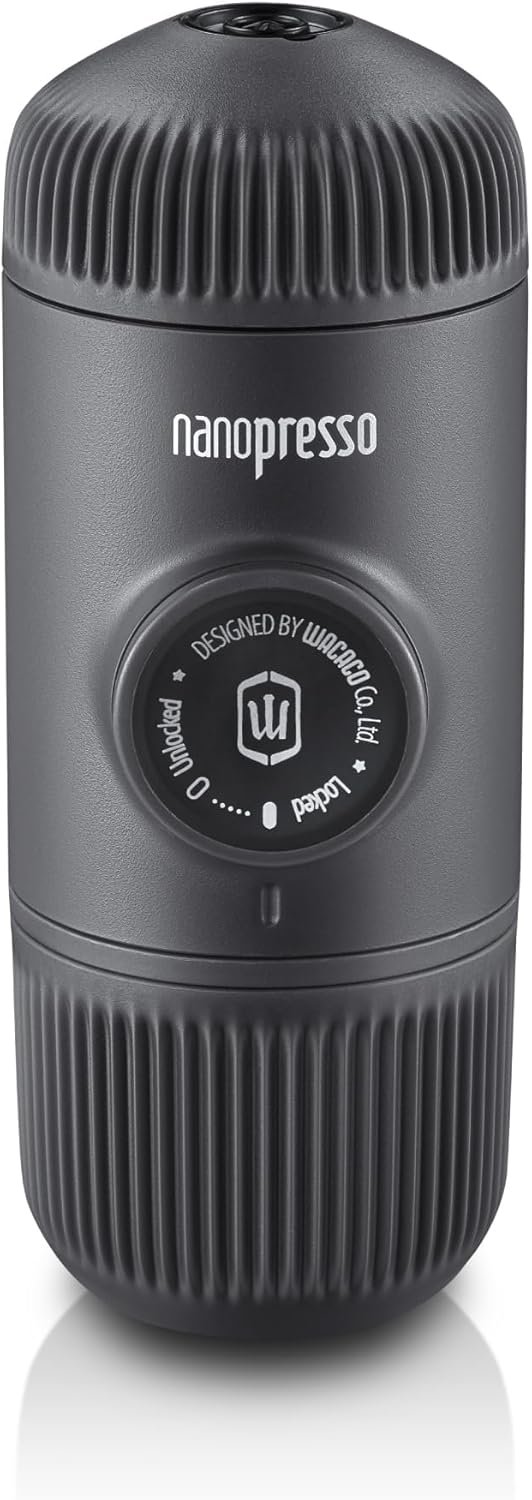
A compact manual espresso maker built around a pressurized basket and a simple, forgiving workflow.
- 8 g standard ground-coffee capacity
- 80 ml water tank
- 336 g / 11.9 oz
- Optional capsule adapter
- Integrated drinking cup

A compact enthusiast-focused espresso maker with a 52 mm basket, naked portafilter, and full puck-prep workflow.
- 18 g stainless-steel basket
- 80 ml water tank
- 350 g / 12.35 oz
- Naked portafilter
- Tamper, funnel and distribution tool included
Nanopresso vs Picopresso: Quick Comparison
The most important point is that 18 bar on the spec sheet does not make these two brewers equivalent. Basket design, coffee dose, grind precision, puck preparation, and how the pressure is created all change the brewing experience and the result in the cup.
| Feature | Wacaco Nanopresso | Wacaco Picopresso | Advantage |
|---|---|---|---|
| Max pressure | 18 bar | 18 bar | Tie |
| Water capacity | 80 ml / 2.7 fl oz | 80 ml / 2.7 fl oz | Tie |
| Standard coffee dose | 8 g | 18 g | Picopresso |
| Basket | Ø39 mm pressurized basket | Ø52 mm stainless-steel basket | Picopresso for control |
| Portafilter style | Pressurized | Naked / bottomless | Picopresso |
| Recommended grind | Extra-fine | Ultra-fine | Nanopresso is more forgiving |
| Weight | 336 g / 11.9 oz | 350 g / 12.35 oz | Nanopresso |
| Dimensions | 62 × 71 × 156 mm | 71 × 78 × 106 mm | Different shapes |
| Built-in water heater | No | No | Tie |
| Integrated cup | Yes | No integrated cup | Nanopresso |
| Capsule option | Yes, with separate NS Adapter | No | Nanopresso |
| Standard warranty | 1 year | 2 years | Picopresso |
| Best for | Travelers, beginners, convenience-first users | Espresso enthusiasts and grinder owners | Depends on user |
Nanopresso vs Picopresso: Pros and Cons
Nanopresso
Pros
- More forgiving pressurized basket
- Easier for beginners and travel use
- Integrated drinking cup
- Can use compatible capsules with the separate NS Adapter
- Lighter complete brewing workflow when you skip a precision grinder
Cons
- Smaller standard 8 g coffee dose
- Less direct control over puck resistance and extraction
- No built-in water heater
- Accessories raise the total system cost
Picopresso
Pros
- 52 mm, 18 g stainless-steel basket
- Naked portafilter gives useful extraction feedback
- Higher espresso-quality ceiling with fresh coffee and a capable grinder
- Includes key puck-prep tools and a protective case
- Two-year manufacturer warranty
Cons
- Much less forgiving of grind and puck-prep mistakes
- Realistically needs an espresso-capable burr grinder
- No capsule option
- No integrated cup or built-in water heater
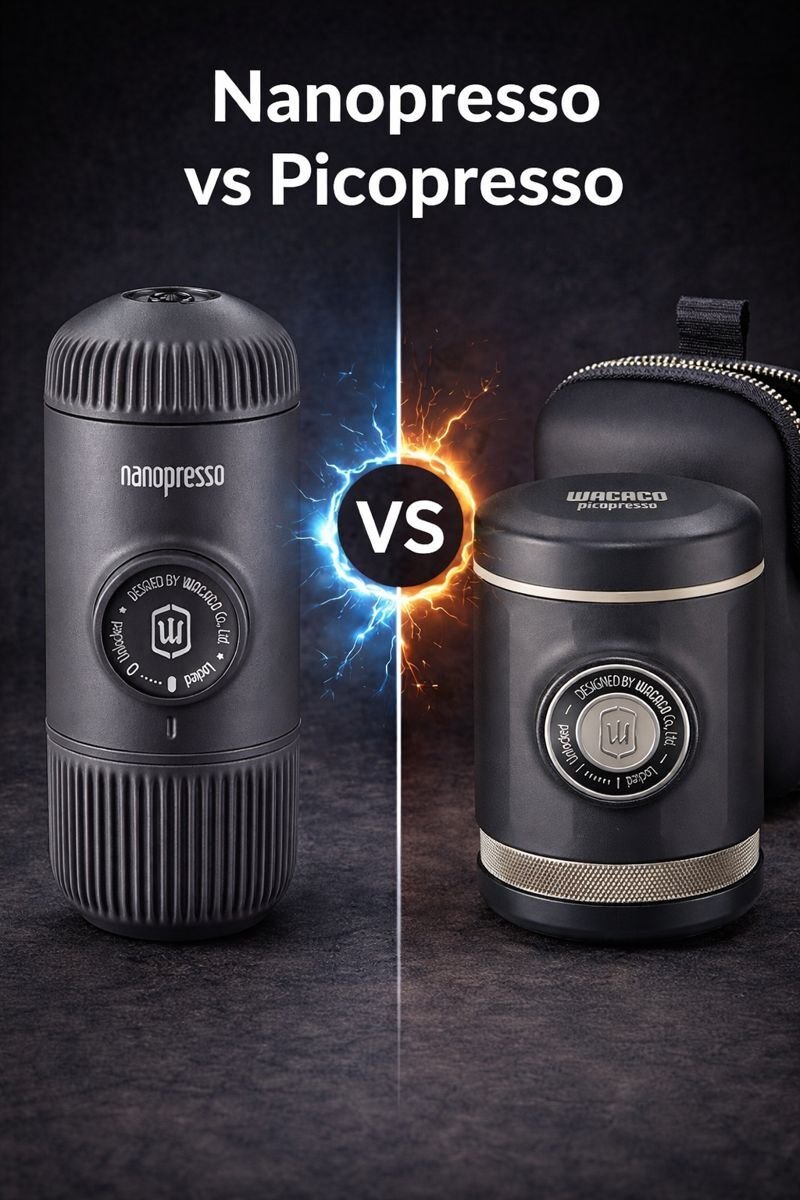
The Biggest Difference: Pressurized Convenience vs Barista-Style Control
If you remember only one thing from this comparison, make it this: Nanopresso is designed to help the user; Picopresso is designed to let the user control the shot.
Nanopresso: forgiving by design
The Nanopresso uses a pressurized brewing system. That extra restriction helps create resistance even when the grind is not perfectly dialed in. It is one reason the Nanopresso works well for travelers who may use pre-ground coffee, a modest grinder, or different beans from trip to trip.
The standard basket holds about 8 g of coffee. That makes the workflow quick, compact, and relatively easy to repeat.
Picopresso: technique matters
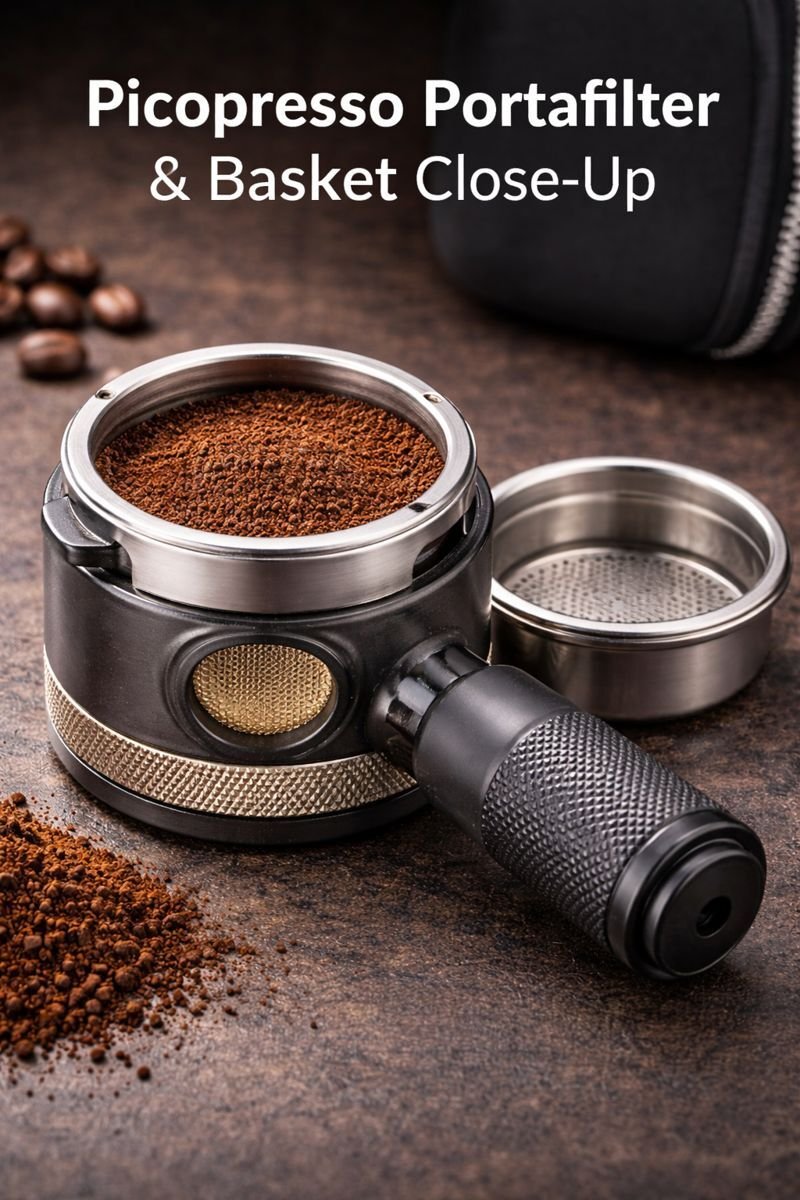
The Picopresso uses a 52 mm stainless-steel basket and a naked portafilter. Resistance comes much more directly from the coffee puck, so grind size, distribution, dose, tamping, and pumping technique matter.
Its 18 g basket is much closer to a conventional double-shot espresso workflow. The result is more potential for body, texture, and flavor clarity—but also more ways to get a poor shot if the preparation is off.
This is why simply asking which machine has “more pressure” misses the point. Both are rated for a maximum of 18 bar, but the Picopresso gives the coffee puck a much larger role in controlling flow.
Espresso Quality: Which One Makes Better Coffee?
Picopresso has the higher espresso-quality ceiling. Its larger dose, non-pressurized basket, and bottomless extraction path give an experienced user more control over flow and extraction. With fresh beans and a capable grinder, it can produce a fuller, more concentrated double shot with more of the texture people expect from traditional espresso.
Nanopresso is less demanding. Its pressurized design can produce a satisfying concentrated shot and visible crema without requiring the same level of puck preparation. That makes it easier to get a decent result repeatedly, especially while traveling.
Best consistency with less technique: Nanopresso.
For a buyer who drinks milk beverages, americanos, or simply wants a strong travel coffee, the difference may matter less. For someone who drinks straight espresso and enjoys dialing in beans, the Picopresso advantage becomes much more important.
Grind Size and Grinder Requirements
This is one of the most practical differences in the Wacaco Nanopresso vs Picopresso decision.
Nanopresso grind requirements
Wacaco recommends an extra-fine grind for the Nanopresso. Because the basket is pressurized, it is more tolerant of small grind inconsistencies than the Picopresso. Freshly ground coffee still helps, but the machine does not punish an imperfect grind as aggressively.
If you do not want to travel with a grinder, Nanopresso also gives you another route: the optional NS Adapter allows compatible Nespresso® Original-style capsules. That can be useful in hotels, at work, or on short trips where convenience matters more than dialing in a shot.
Picopresso grind requirements
Wacaco recommends an ultra-fine grind for the Picopresso. More importantly, the grinder needs to produce a consistent espresso grind and offer small enough adjustment steps to control shot flow.
A basic blade grinder is a poor match for the Picopresso. Even many inexpensive hand grinders can be frustrating if their adjustment steps are too large. If you already own an espresso-capable burr grinder, that is a strong argument in favor of the Picopresso.
No espresso-capable grinder? Nanopresso is the safer choice.
Already own a good grinder and enjoy dialing in coffee? Picopresso makes much more sense.
Brewing Workflow: Which One Is Easier to Use?
Nanopresso workflow
- Heat water separately.
- Add roughly 8 g of extra-fine ground coffee to the basket.
- Assemble the brew head and fill the 80 ml water tank with hot water.
- Unlock the piston and pump steadily over the cup.
- Disassemble, discard the grounds, rinse, and dry.
The Nanopresso routine is relatively easy to learn because the pressurized basket does some of the flow-control work for you. That makes it a better choice when you are brewing half-awake in a hotel room, at a campsite, or during a work break.
Picopresso workflow
- Heat water separately and preheat the brewer when possible.
- Grind an espresso-fine dose for the 18 g basket.
- Use the funnel and distribution tool to prepare the puck.
- Tamp evenly and assemble the portafilter.
- Add hot water to the 80 ml reservoir.
- Begin pumping, allow a short preinfusion, then continue the extraction.
- Inspect the bottomless extraction and adjust grind or puck prep for the next shot if needed.
The Picopresso is not difficult in the sense of being complicated machinery. It is demanding because the coffee preparation matters. If that sounds enjoyable rather than annoying, you are exactly the type of buyer it was designed for.
Portability: Which Is Better for Travel and Camping?
Both are genuinely portable. The Nanopresso weighs 336 g, while the Picopresso weighs 350 g, so the body-weight difference is only 14 g. The bigger difference is the supporting gear you are likely to carry.
The Nanopresso is tall and narrow, has an integrated cup, and can work with a more forgiving coffee setup. Add the capsule adapter and you can travel without a grinder at all. That is why we consider it the better all-around travel choice.
The Picopresso is shorter and wider and includes a protective case, but serious use normally means carrying fresh beans, an espresso-capable grinder, and often a small scale. The brewer itself is compact; the complete barista-style travel kit is not as minimal.
Choose Nanopresso for
- Hotel rooms
- Road trips
- Office drawers
- Casual camping
- Travel without a precision grinder
Choose Picopresso for
- Espresso-focused travel
- Van-life setups with a good grinder
- Home use in a small kitchen
- Campers who already carry coffee gear
- Users who enjoy dialing in every shot
Neither machine heats water. If your travel setup does not give you reliable access to near-boiling water, a self-heating electric model may be more practical. You can compare other options in our portable espresso maker hub.
Cleaning and Maintenance
For daily cleanup, both machines are manageable, but they reward different habits.
Cleaning the Nanopresso
Discard the grounds, rinse the basket and brew head, then allow the parts to dry before reassembly. The pressurized system has small passages that should not be allowed to accumulate coffee oils or fine particles. If your unit begins to leak or behave differently, our Nanopresso leaking-water troubleshooting guide covers the most common causes.
Cleaning the Picopresso
The removable basket and naked portafilter make the coffee-contact surfaces easy to see, but the Picopresso includes more small puck-prep pieces to keep organized. After brewing, knock out the puck, rinse the basket and portafilter, wipe the brewer, and dry everything before packing it into the case.
If you are camping where water is limited, the simplest routine wins—and that usually favors Nanopresso. At home or in a hotel with easy access to a sink, the difference is much smaller.
Capsules, Accessories, and Upgrade Options
Nanopresso accessories
Nanopresso is the more modular ecosystem. The NS Adapter adds compatibility with Nespresso® Original-style capsules, while the Barista Kit expands the system for larger coffee doses and double-shot-style brewing. Cases and other travel accessories are also widely available.
That flexibility matters if your routine changes. You can use ground coffee at home, capsules in a hotel, and add the Barista Kit later rather than replacing the entire brewer.
Picopresso accessories
Picopresso already arrives with much of the puck-prep kit an enthusiast needs: an 18 g basket, tamper, scoop, brush, distribution tool, funnel, and protective case. Wacaco also offers alternate basket sizes, including a smaller 12 g option.
What the Picopresso does not offer is the capsule-first convenience of the Nanopresso. Its entire reason for existing is traditional ground-coffee espresso preparation.
Price and Value: Is Picopresso Worth Paying More For?
Retail pricing changes, so it is better to judge these machines by the value of the complete setup rather than a single snapshot price.
Nanopresso usually makes more sense as the value choice because the brewer is simpler to use and does not require a high-end grinder to be enjoyable. However, accessories such as the NS Adapter or Barista Kit can raise the total cost if you want the full ecosystem.
Picopresso makes sense when espresso quality is the priority. The brewer itself is only part of the investment. To use it well, budget for fresh beans and a grinder capable of espresso-level adjustment. If you already own that grinder, the Picopresso becomes a much stronger value proposition.
Check current prices
Amazon prices and availability can change. Use the buttons below to see the current listings.
Which One Should You Buy?
There is no universal winner because the two brewers are aimed at different people. Use the checklist below instead of choosing by pressure rating alone.
Buy the Nanopresso if...
- You are new to manual portable espresso.
- You want a simpler and more forgiving workflow.
- You may use pre-ground coffee or capsules while traveling.
- You care more about convenience than maximizing espresso extraction.
- You want an integrated cup and a compact grab-and-go setup.
- You do not own an espresso-capable grinder.
Buy the Picopresso if...
- You mainly drink straight espresso.
- You already own—or are willing to buy—a capable burr grinder.
- You enjoy weighing, distributing, tamping, and dialing in coffee.
- You want an 18 g double-shot basket.
- You want a naked portafilter and visual feedback during extraction.
- You are willing to trade simplicity for a higher espresso-quality ceiling.
Nanopresso is the better recommendation for the average traveler. It asks less of the user, works with a wider range of coffee setups, and is easier to use when convenience matters.
Picopresso is the better recommendation for the espresso enthusiast. If you already care about grind size, dose, puck preparation, and extraction, it gives you much more room to chase a café-style shot in a remarkably small package.
Where Does the Minipresso Fit?
If you are also considering Wacaco’s Minipresso line, think of it as the more basic entry point in the family. Nanopresso moves toward easier everyday versatility, while Picopresso moves in the opposite direction toward enthusiast espresso. For a closer look at the Minipresso versions, see our Minipresso NS vs GR comparison.
You can also compare the broader category in our best manual portable espresso maker guide.
Nanopresso vs Picopresso FAQ
Which is better, Nanopresso or Picopresso?
Picopresso is better for espresso enthusiasts because its 18 g, 52 mm basket and naked portafilter provide more control and a higher shot-quality ceiling. Nanopresso is better for beginners and travelers because its pressurized basket is easier and more forgiving.
Does Picopresso make better espresso than Nanopresso?
With a capable grinder, fresh coffee, and good technique, Picopresso can produce a more traditional double espresso with greater body and extraction control. Nanopresso is easier to use consistently but offers less control over the puck and flow.
Do Nanopresso and Picopresso both reach 18 bar?
Wacaco lists a maximum pressure of 18 bar for both models. That does not mean they brew identically. Their basket designs, coffee doses, and extraction workflows are fundamentally different.
Can Picopresso use Nespresso capsules?
No. Picopresso is designed around ground coffee and its 52 mm basket. Nanopresso can use compatible Nespresso® Original-style capsules when fitted with Wacaco’s optional NS Adapter.
Do I need a grinder for Picopresso?
For good results, yes. Picopresso needs a consistent ultra-fine espresso grind and benefits from small adjustment steps. A proper burr grinder is one of the most important parts of a successful Picopresso setup.
Can I use pre-ground coffee in Nanopresso?
Yes. Freshly ground coffee is preferable, but the pressurized basket makes Nanopresso more tolerant of pre-ground coffee than Picopresso. The grind should still be fine enough for espresso-style brewing.
Which Wacaco is better for camping?
Nanopresso is the better fit for most campers because it is forgiving, includes a cup, and can be used without carrying a precision espresso grinder. Picopresso is better for campers who prioritize espresso quality and already carry a capable grinder.
Do Nanopresso or Picopresso heat the water?
No. Both are manual espresso makers and require hot water from a kettle, stove, or another heat source.
Final Verdict: Nanopresso or Picopresso?
The best way to settle the Nanopresso vs Picopresso debate is to decide what you want from portable espresso.
If the goal is good coffee with minimum friction, choose the Nanopresso. Its pressurized basket, smaller standard dose, integrated cup, and optional capsule adapter make it a practical companion for travel, camping, office use, and beginners.
If the goal is the best espresso you can coax from a manual brewer this small, choose the Picopresso. The 18 g basket, naked portafilter, and barista-style workflow demand more skill but give you much more control.
Ready to choose?
Keep the decision simple: Nanopresso for convenience; Picopresso for espresso control.